

STUDY OVERVIEW
Three studies, one safety question
- Three in vivo studies evaluated safety and biocompatibility of cryopreserved equine umbilical cord (UC) allograft.
- Focus on musculoskeletal (MSK) tissues: joints, ligaments, and tendons.
- Assessed in clinically normal horses, horses with MSK disease, and through histopathology.
STUDY ONE
1. Controlled study in normal horses
Design
Randomized, masked, crossover study with 8 horses. UC allograft injected into joints and ligaments; saline as control.
Findings
- No lameness, pain, or swelling post-injection.
- Transient synovitis resolved by Day 5–10.
- No systemic inflammation (normal SAA levels).
- Increased anti-inflammatory cytokines (IL-1ra, IL-10).
- IL-1ra/IL-1 ratio improved >4-fold.
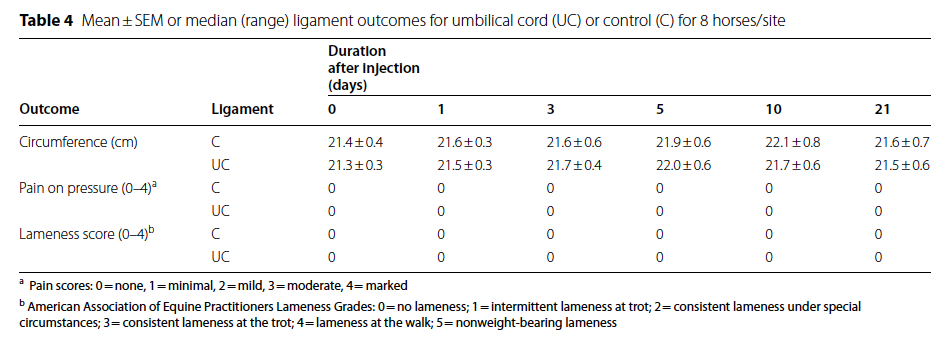
Table 4 — Mean ± SEM or median (range) ligament outcomes for umbilical cord (UC) or control (C) for 8 horses/site.
STUDY TWO
2. Case series in diseased horses
Subjects
3 horses with osteoarthritis, desmitis, and tendonitis.
Intervention
Single UC injection into affected tissues.
Findings
- No adverse events or systemic inflammation.
- Improved lameness and pain scores.
- Synovial fluid returned to baseline by Day 3.
- Increased anti-inflammatory cytokines.
- No tissue damage on imaging.
STUDY THREE
3. Controlled pathologic study
Subjects
2 horses received multiple UC injections.
Assessment
Histologic evaluation of joints, ligaments, and lymph nodes.
Findings
- No immune reaction or tissue damage.
- Mild inflammation only at needle tracts.
- No foreign body response or lymph node activation.
CONCLUSION
What the safety data shows
- UC allograft demonstrated excellent local and systemic safety.
- No adverse immune or inflammatory responses observed.
- Consistent anti-inflammatory effects and histologic biocompatibility.
- Supports use as a safe injectable biologic for MSK tissue supplementation.
Reference
1 Bertone, AL et al. “Cryopreserved equine umbilical cord tissue allograft characterization and biocompatibility in vivo in musculoskeletal tissues: a controlled study.” BMC Medicine, 2025.
Ready to explore equicenta® CTM for your practice?
The peer-reviewed data speaks for itself: consistent protein profiles, proven biocompatibility, and measurable clinical outcomes in musculoskeletal conditions.
Get More Info